Trouble with finding diagnoses

Dear Community! :)
We are somewhat surprised by the low number of patients in the Biobank who have an intracranial aneurysm.
To be more precise: The prevalence of this disease is 10x lower than the actual prevalence in western Europe.
When creating our cohorts, we applied the following parameters for filtering:
- Summary Diagnoses (filtered with “OR”), total of 955 cases
- Diagnoses - ICD10 (Data-Field 41270) filtered for “I67.1”
- Diagnoses - ICD9 (Data-Field 41271) filtered for “4373”
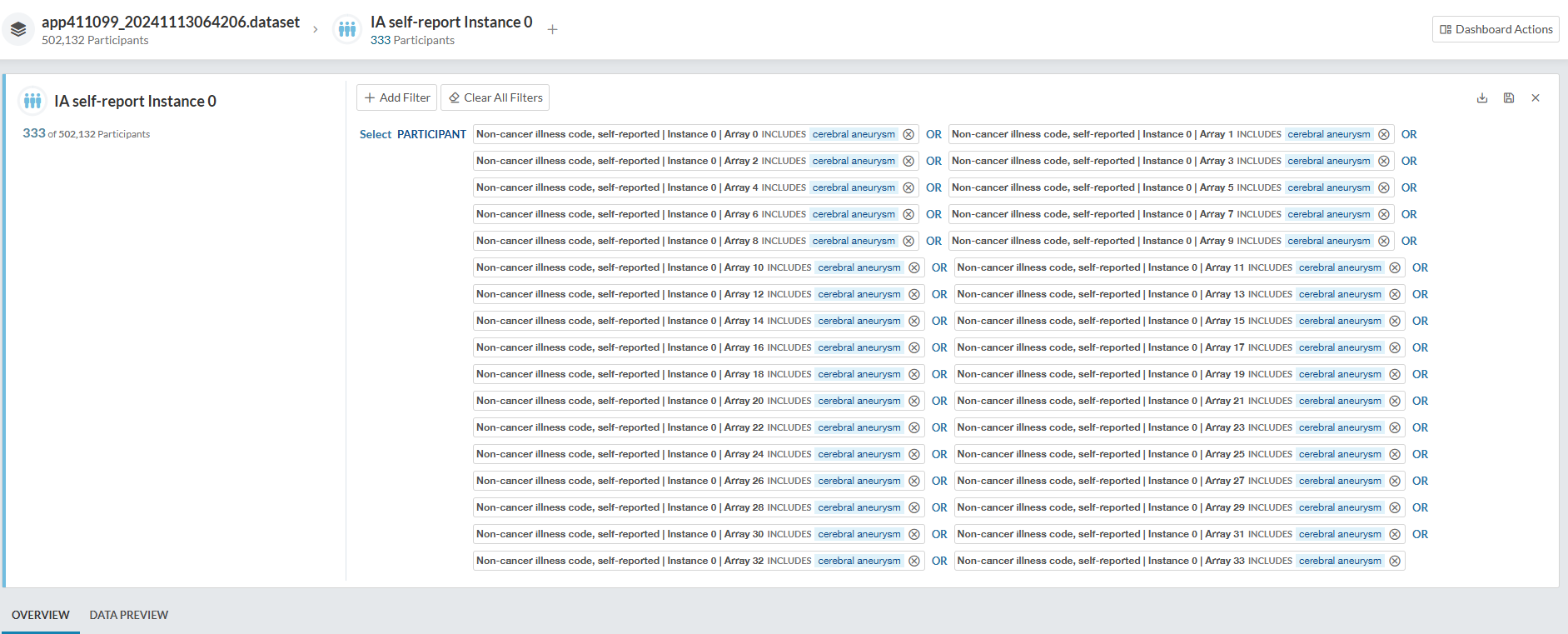
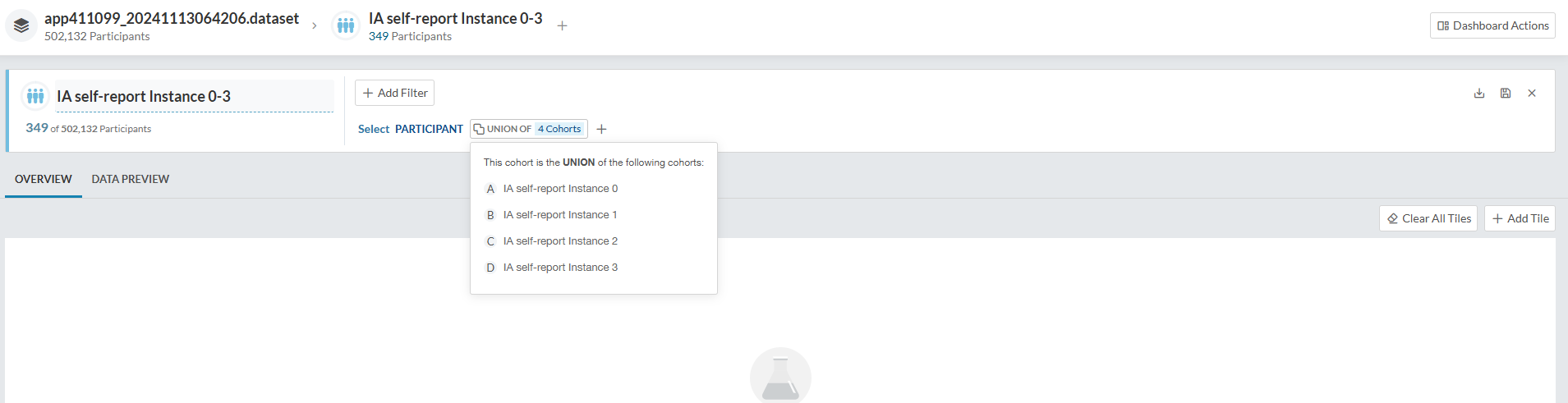
- Union of Self-reports across Instances 0-3, each one for Arrays 1-33: total of 349 cases
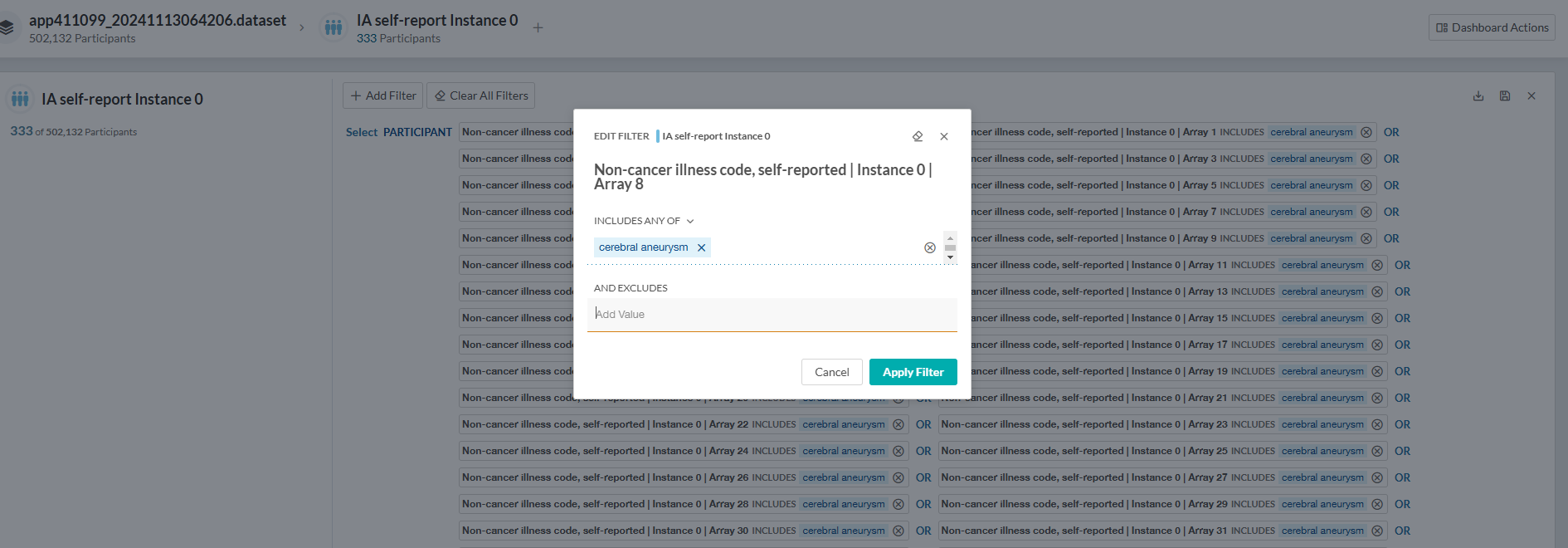
- Non-cancer Iillness code, self-reported (Data-Field 20002) filtered with “OR” for “cerebral aneurysm”
Please find also some screenshots below to visualize our specific filtering methods.
After removing duplicates, we arrived at a total of 1,197 cerebral aneurysms.
This corresponds to a prevalence of approximately 0.24% given the total number of 502,132 participants in UK Biobank.
However, the prevalence of intracranial aneurysms in our region is approximately 3% *, which is more than ten times higher.
For this reason, we are puzzled and suspect that we may have overlooked an important category when creating our cohorts.
Are there additional filtering options or specific categories we could use to identify more cases of intracranial aneurysms?
We would be incredibly grateful if you could assist us or have any ideas in resolving this issue!
We look forward to your response and remain with kind regards,
Robin Kaus
*(see: Vlak MH, Algra A, Brandenburg R, Rinkel GJ. Prevalence of unruptured intracranial aneurysms, with emphasis on sex, age, comorbidity, country, and time period: a systematic review and meta-analysis. Lancet Neurol. 2011;10:626-636. doi: 10.1016/S1474-4422(11)70109-0)
Screenshots:

Comments
4 comments
Hi Robin,
As a very broad point, it's quite a common observation that UKB, for all its excellent points (etc etc.) is quite a healthy and rarefied population. The prevalence of quite a few things (e.g. TBI) is very low, so this doesn't surprise me, personally, and I think what you've probably found is ‘true’.
There are a good few papers on how relatively healthy people made it to the assessment, then relatively healthy people have tended to re-attend.
https://pubmed.ncbi.nlm.nih.gov/30938313/
https://pubmed.ncbi.nlm.nih.gov/28641372/
https://www.medrxiv.org/content/10.1101/2023.10.06.23296652v1
https://academic.oup.com/aje/article/193/5/787/7425625
In sum: I'm not too surprised by this finding and you've potentially done all you can. Although I'm not 100% clear from the notes that 41270/1 include ‘cause of death’ codes, where you'd want 40001/2 as well. (I think it does, but can't hurt to check).
Best wishes,
Donald.
Dear Donald,
thank you for your opinion on this issue!
That sounds very logical to me especially since it´s somehow proved by the papers you sent as well.
In the process of looking out for aneurysms i came across this article:
https://community.ukbiobank.ac.uk/hc/en-gb/articles/15467565352093-Health-related-outcomes-data
However, the category “first occurences of medical conditions” is quite superficial. ICD10 Codes in there are just categorized within the first two digits (e.g. I67 is all you get which leads to a total of about 13.000 cases).
I´ll definitely check the categories you mentioned!
Best wishes,
Robin
I encountered similar issues during diagnosis as well. May I ask if your final filter still includes those shown in the screenshot above? Because the category 'first occurrences of medical conditions' in the ICD-10 Codes is just categorized by the first two digits (e.g., I67 is all you get, which leads to a total of about 13,000 cases), but this doesn't represent a diagnosis of a brain aneurysm.
Also, did you add the diagnoses 41270, 41271, 40001, and 40002 in the end? When I added the diagnoses above, the numbers displayed were not correct. The diagnoses became 'AND' instead of 'OR
Please sign in to leave a comment.