blood phosphate levels change

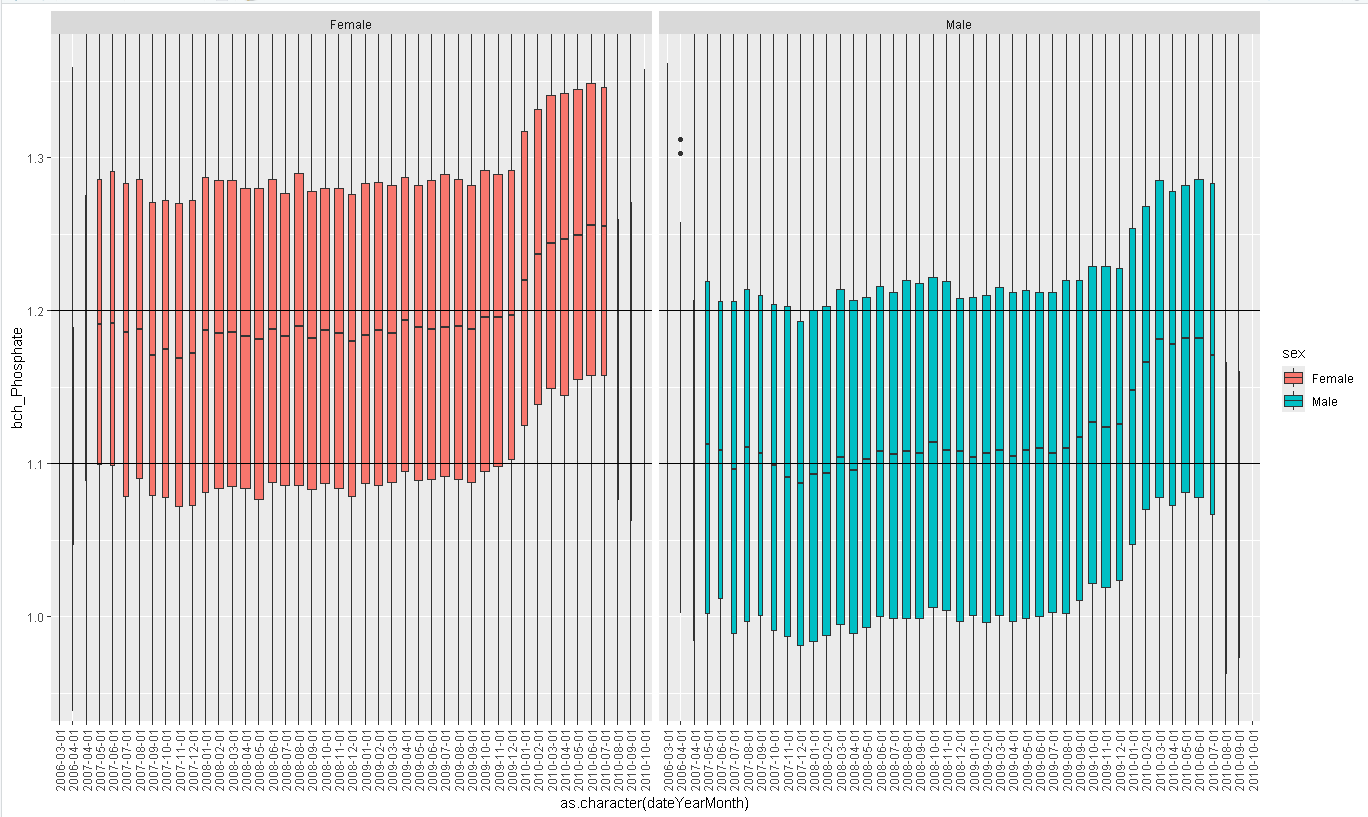
if we liook at the blood phosphate (and others) level distributions v date the blood was drawn , they seem to change around 2010. Is this because the labs analysing the blood has changed? Did the Welsh centres not change as they don't seem to be impacted. Is there any info in this I haven't come across?
Comments
8 comments
Blood phosphate levels are in Category 17518 Blood Biochemistry These assays were performed several years after the samples were collected, unlike the assays in Category 100081 which were performed on the day of collection. Have you seen the associated Resources 1227 and 5636 ?
The samples were sent for assay in a semi-randomised sequence, so any underlying date-related issue would probably relate to the blood sampling processes rather than the assay performance. During 2006-10 there were several different local assessment centres opened and closed. It may be that the difference in 2010 relates to the underlying local populations, or to processes in one particular centre. Is there any specific centre with higher-than-normal values?
I have not seen this pattern before, but I will check whether it is known. If any other researchers know about it, please let us know your insights.
there are centres with higher than normal values, but that is because the centres are time related.
There is a graphic about enhancements to baseline assessments in the Essential Information, see https://biobank.ndph.ox.ac.uk/~bbdatan/clinic_timelines.pdf . This suggests that Wrexham did not use the 2nd or 3rd enhancements, even though it was the latest clinic, and that Swansea did not use the 3rd enhancement. It doesn't seem likely that “further eye measures, fitness assessment with ECG” could affect the amount of Phosphate in a blood sample, but maybe there was a change in timings that affected the sample somehow. Looking at Middlesbrough, which didn't have an enhancement and doesn't show a rise in 2010, I think this is related.
yes, the time points in that graphic seems to match with what I've observed but as you say, it's hard to see why it would change anything. Do we know if anything else in the process changed at the same times?
Do we know if the blood was taken before or after the fitness assessment?
Resource 100227 written in 2011 includes this
So, Blood samples were collected after the fitness assessment.
Would that be likely to affect blood Phosphate levels?
Thanks Rachael, I think that would explain it.
I'm not medical, but based on this evidence exercise would seem to increase phosphate levels.
Is there a field in the data that will identify those who had the 3rd version of the assessement so we can filter them out, or will it need to be a manually coded process?
Category 100012 https://biobank.ndph.ox.ac.uk/showcase/label.cgi?id=100012 has various fields that would work. Notice particularly Field 6019 https://biobank.ndph.ox.ac.uk/showcase/field.cgi?id=6019 which identifies participants who did the cycling, or Field 6033 https://biobank.ndph.ox.ac.uk/showcase/field.cgi?id=6033 which gives max heart rate during fitness test.
Thanks again for raising this. We expect to add a note in Showcase to warn other researchers about it.
Please sign in to leave a comment.